
“Shhh.”
A head peeks through our performance curtain, an index finger pressed to his lips.
“Shhh,” William whispers again. He walks cautiously into our performance space and sits down on “his” bench.
With his right hand, he adjusts his “invisible” hat and gives me a slight bow. I do the same to him. The corners of his mouth turn up, and he gives me a broad, toothless smile.
I can’t help but smile back—his sincere presence is that contagious.
It’s one of our regular rituals that has developed over the past few weeks; initiated not by me, but by William.
It’s 10:05 a.m., and our performance day has begun again—day 15 of 35.
For 20 minutes, William and I sit alone in the performance space, just the two of us. I’m on the performance floor, ready to perform. He’s on the audience bench, watching me calmly and patiently. We do nothing; we’re simply there. Together, we wait for the first audience members to arrive. Then William quietly slips away.
Motus Mori—the archive of human movement
During the Watou Arts Festival 2026, my team and I will be performing for two months at De Lovie Castle with our multi-year project Motus Mori, the archive of human movement.
We are all professional dancers/movement artists, but we often work at the intersection of dance and visual art, as well as in collaboration with the people and social context of the place where we work.
Since 2019, we have been traveling from city to city, collecting the movements of people of all ages, body types, and backgrounds.
More than 2,500 people have now donated their movements to our archive, including residents of De Lovie vzw. Our team of dancers—Eleni, Anton, Ornella, Maria, Boris, Josy, and I—are performing these thousands of personal movements for eight hours a day at Kasteel de Lovie.
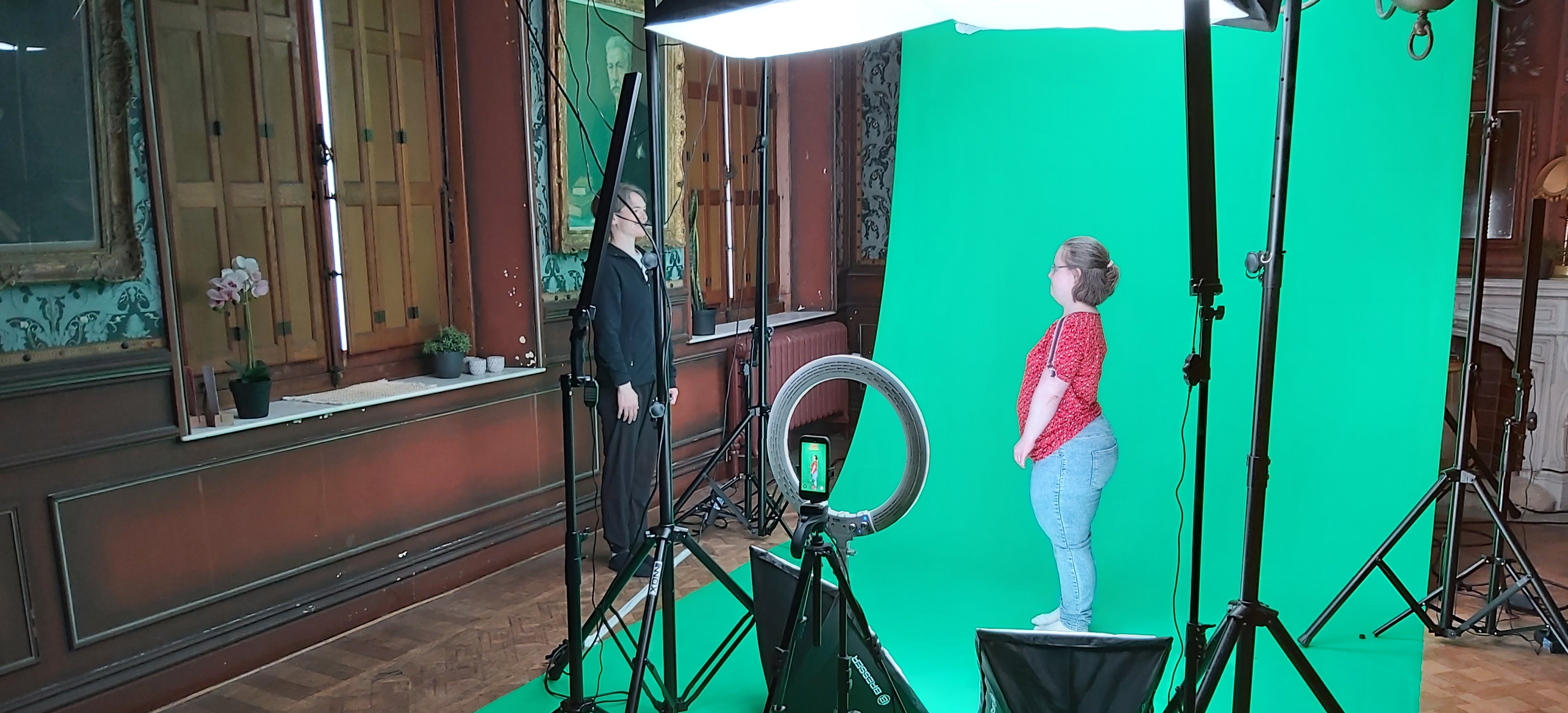
In May, we began our collaboration with Studio Artilerie at De Lovie. We interviewed fifteen residents about their movements – how they walk, stand, or make a very personal gesture… Afterward, we filmed a personal movement portrait with each of them.
For this video portrait, we created a choreography with each participant based on his or her personal movements.
These video portraits are presented as life-size projections within our exhibition. Each projection screen has its own audio speaker, so you can hear each person’s personal motivation.
Because the way someone moves often reveals what moves them…
Jason and the resolute gesture of doubt
“I’m a doubter,” Jason says resolutely, without a shred of doubt.
“But sometimes I’m not.”
During the interview, he showed me how he places his thumb and middle finger under his chin when he’s in doubt and needs a moment to think.
As soon as he’s made a choice, he puts his hands on his hips. His right arm points straight ahead with determination. “Then I’ll just do it until I start doubting again.”
The doubt became tangible when we started recording his voice. Sometimes I asked him to repeat a sentence and speak it a little slower. I noticed right away that Jason found this difficult, and it made him doubt whether he was doing it right.
We switched roles: Jason got to decide for himself when he thought a take was good. With conviction, he then recorded the sentence several times, each time a little slower. Afterward, he judged it himself: “Yeah, this one’s definitely the best. I really nailed this. It doesn’t get any better than this.”
Every trace of doubt had vanished.
Determination and doubt actually need each other to keep us moving forward.
Sandra and the Anatomy of Empathy
The movement interview with Sandra became a mirror for myself.
When I asked her how she walks, she simply began to mimic my way of walking and said very enthusiastically, “Yes, just like you.”
Sandra showed an enormous sensitivity toward others, which she literally incorporates into her own body. I looked at her and saw my own hand gestures reflected in hers.
I noticed that I was becoming insecure because I specifically wanted to learn her movements but couldn’t, since she was mainly mirroring me.
Of course, Sandra sensed my insecurity and subsequently became insecure as well.
Then I began to realize that Sandra was intuitively doing what I’ve been practicing with my dancers for years: how to put yourself in the other person’s shoes.
Sandra is the embodiment of empathy—that we all exist only through the other.
Will our world lose empathy if fewer people with Down syndrome are born in the future?
Patrick: “For me, freedom of movement means the ability to frame my own perceptions.”
This is what Patrick concluded at the end of the interview.
To see is to move. Patrick sees movement everywhere he looks.
He forms an L-shape with both hands using his thumbs and index fingers, creating a rectangular frame. He holds this finger frame up to a blank white wall, stares at it intently, and rotates his hands until the frame feels right to him: “This is fascinating—this transition from shadow to light.”
I ask him if I can look through his frame. When I looked at that white wall through Patrick’s eyes, I finally saw the depth of the shadow in relation to the light. A movement emerges between shadow and light.
He explains to me that he has developed this technique throughout his entire life, in order to then draw his frame of reality. What began as a drawing technique became a technique for life.
Since being diagnosed with Parkinson’s, he sometimes uses it to consciously keep hallucinations out of his field of vision.
I wish everyone could look through Patrick’s frame at least once and see the world through his eyes.
Louis and the Art of Staying Close to Yourself
The interview with Louis evolved into a duet with his caregiver, Filip.
When we started, I quickly sensed that Louis would withdraw as soon as he felt any expectation from me. His body literally turned away, and his head ducked into the crook of his elbow—away from me, away from the expectation, closer to himself.
It wasn’t that he couldn’t do what I asked. It wasn’t that he was resisting or blocking it. I could feel his will, but together we hadn’t yet found the right path.
I was quite impressed that Louis managed to stay true to himself in such a tense situation in our film studio and didn’t give in to the other person’s expectations.
It fascinated me that Louis simply wouldn’t let himself be framed. How could we showcase this strength within the installation?
To show that someone won’t let themselves be framed, you actually need a frame. And that’s where his mentor, Filip, came into play as a duet partner.
We flipped the script, and during filming I deliberately gave all the instructions to Filip alone. Interestingly, Louis now did follow everything. Sometimes it became too much for him, and he would literally step out of the frame while filming.
Then Filip would stand there alone until Louis decided to rejoin him.
Louis’s motivation didn’t seem to stem from external factors but rather from intrinsic ones.
I recognize this; as an artist, it’s also very tempting to create what people expect of you, but that’s precisely when it becomes boring and predictable. Yet it takes a great deal of steadfastness to distance yourself from the audience’s expectations and stay true to yourself.
Now, when we perform for hours on end during the festival, we’re constantly in contact with hundreds of visitors and their expectations. It’s tempting to let that influence your performance and to speed things up when the audience gets restless. The trick, however, is to slow down and take them along at a different pace.
To stay true to the work and to yourself.
That’s when I always think of Louis for a moment.
William and the Beauty of Being
It’s 5:15 p.m. Forty-five minutes left to perform, and then the festival closes.
William is sitting on his usual bench. New visitors are coming in.
William points out where they can sit.
As soon as William sees someone trying to take a photo, he immediately raises his index finger and says “no,” just as he does when someone steps onto our dance floor or talks too loudly.
What’s remarkable is that I never asked William to do this or explained it to him. It just came naturally to him.
The first time he walked into our space during a rehearsal, he put his index finger to his lips and said, “Shh.” This developed into a daily ritual.
It’s striking that William intuitively senses the unwritten rules that apply in a museum space. He immediately understood that you’re supposed to be quiet in this performance space, and where you should and shouldn’t sit. An empathetic ability that some visitors need explicit instruction signs to grasp.
William has been there since we began setting up in early July. He integrated himself into our team—without words, but simply by being there. Without a predetermined goal or task, he created his own role.
Whenever I actively tried to involve him, he would actually withdraw.
He made me realize that expectations and progress can often get in each other’s way.
It was precisely when there were no expectations from the other side that William began to take the initiative. Every day he said a little more, opened up a little more.
I think this is a trait many people can recognize in themselves.
But in a society where we approach one another with a goal-oriented mindset, and where little patience or time is devoted to one another, we’ve actually lost sight of this realization.
It would be tempting to think now that William could take on the role of audience guide. But it is precisely this goal-oriented approach that would not do justice to his role in our project.
I believe William’s greatest talent lies in his pure physical presence, precisely because he withdraws from any task driven by expectations. That is his strength.
The Korean-German philosopher Byung-Chul Han put it this way:
The human gait, liberated from the “in order to”—from purposeful walking toward something—becomes a dance: “But what is dance other than the liberation of the body from its utilitarian, functional movements, the display of gestures in their pure non-functionality?”
Precisely because William waits with me for the audience every morning—simply being there and not “performing”—he can show us once again the beauty of human existence.
If William isn’t there one day, we miss his presence.
Motus Mori INSTITUTUM was presented during the Watou Arts Festival 2026, at De Lovie Castle.